New or long-time — these notes are about making 511 a successful place to live. A big building works when people give each other a little room and a little care.
First week
New to 511? Work down this list. Details are in the sections below, or on Access, Trash, Emergencies, and Moving.
Put your unit number on every piece of mail and every package. That is how the post office and carriers match deliveries to the right box and the right hands.
The mailroom is a shared landing spot, not long-term storage.
Pick up soon after delivery so walkways stay clear and boxes find the right hands.
Do not leave packages in the mailroom for more than 30 days. After 30 days they will be removed.
Laundry (2nd floor)
Payment is by phone app — the name is printed on the machine. Create an account before you bring a basket down.
When your cycle ends, grab your clothes so the next neighbor can start theirs.
Leave the room as you’d like to find it: lint traps cleared, detergent put away, nothing left on top of the machines.
Left: the door, off the second-floor hallway. Right: inside, with the payment, repair, and rules signs on the wall.
Fire room — shared equipment
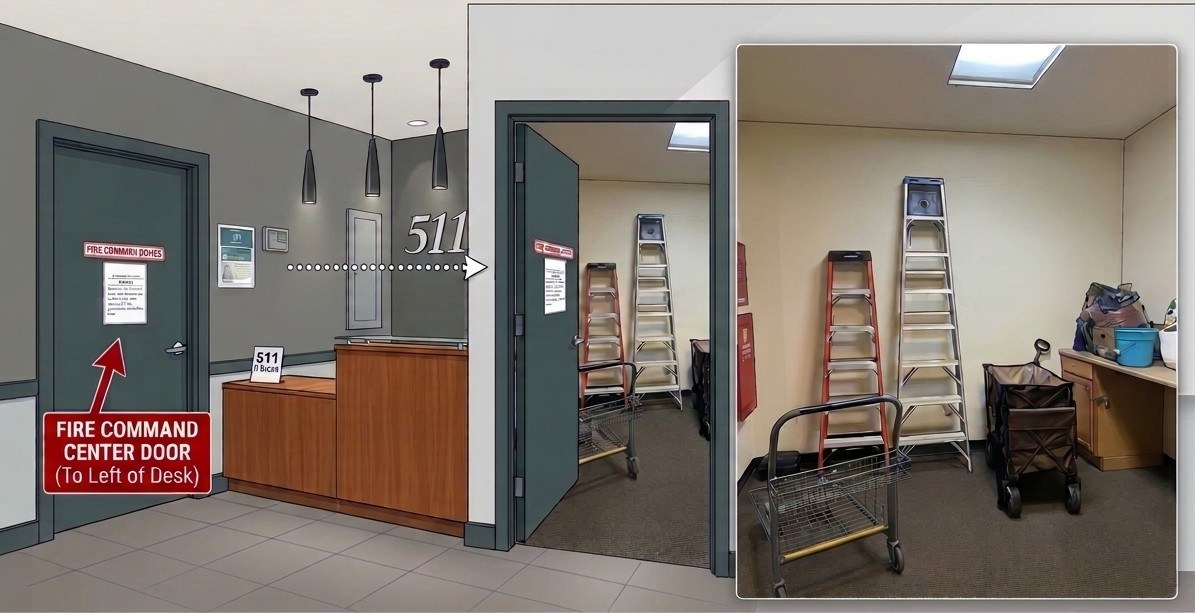
Carts and ladders live in the fire room. Use is entirely at your own risk. The building / HOA assumes no liability for personal injury or damage to belongings.
Carts — for loading and unloading.
Ladders — for hard-to-reach spots.
Inspect before each use. Do not use cracked or damaged gear. Report wear to building management so it can be taken out of service.
Go easy in elevators, doors, and hallways so walls and trim stay intact.
Return everything to the fire room right after use. Do not leave carts or ladders in hallways, elevators, or units.
The fire room is the door marked Fire Command Center, left of the lobby desk.
Hallways and stairs
Keep corridors clear so neighbors and emergency crews can move. Trash, boxes, bikes, and personal items belong in units, not in the hall or lobby.
Smoke outside — not in stairwells, hallways, elevators, or indoor community spaces.
If a detector is going off inside your unit, deal with it in the unit. Don’t open the hallway door to air it out — that can trip the building alarm. See Emergencies.
E-bikes and e-scooters: ask building management first
Before you bring an e-bike or e-scooter into 511, check with building management on what is allowed — taking it through the lobby and elevators, storing it, or charging its battery in your unit. The concern is fire.
The lithium-ion batteries that power e-bikes and e-scooters can overheat and burst into flame with little warning, often while charging. These fires burn hot, spread fast, give off toxic smoke, and can reignite after they look out. In a ten-story building, one battery fire puts every floor at risk.
A cautionary tale from October 2026. Around 3:30 a.m. on October 11, 2026, an e-bike battery in an upstairs bedroom started a fire in a Kensington rowhome on D Street. A 3-year-old girl died that morning; her 22-year-old mother died days later. In June, a charging e-bike battery started a fire on S. Mildred Street in South Philadelphia that killed two people — that home had working smoke alarms, and the fire still moved too fast. Philadelphia firefighters now answer nearly one lithium-ion battery call a week. (Inquirer, Billy Penn)
Left: maker’s charger, daytime, unplug when full.Right: swelling, heat, smell, or hissing — get out and call 911.
Ask building management through the Resident portal what is allowed before you store or charge an e-bike or e-scooter here. The Facebook group knows where neighbors keep theirs.
Any battery you charge at home (e-bikes, scooters, tools, laptops): use the maker’s charger, don’t charge overnight or while you’re out, unplug when full, and keep them away from your door.
Stop using any battery that swells, gets hot, changes color, or smells odd. Hissing, popping, or smoke means get out and call 911 — Emergencies.
Batteries never go down the chute or in recycling — Trash.
Hallway heat and A/C
Common-area HVAC is set for the building, not for living-room comfort. It manages humidity, protects pipes, and keeps shared energy bills from spiking.
Summer: about 76°F — limits humidity and cooling load.
Winter: about 66°F — protects plumbing and holds a base warmth.
That’s hallways and shared spaces, not your apartment. In-unit heat and A/C are yours (or the landlord’s) — Find these first.
Doors and census
Don’t hold the door for people you don’t know. Limit lobby, stair, and elevator access to residents and invited guests. Guests use the 2N callbox — Access.
Make sure doors close behind you. If one won’t latch, tell building management so it can be fixed.
Keep your census current with building management so fobs and building access stay accurate. Fobs.
Pests
If you see pests in your unit or a common area, use the Resident portal.
Tied, sealed trash and no food or bags in hallways make a big difference. Trash.
A 10-minute walk from the door
511 sits on the Callowhill side of Broad and Spring Garden. More dining and maps: broadandspringgarden.com.
Subway
Broad Street Line (B) — Spring Garden station is at the intersection, outside the front door.
Buses
Routes 4 and 16 stop on Broad; 43 runs on Spring Garden. Overnight, the Broad Street owl bus covers the subway. Check the SEPTA app — numbers change.
Don’t leave bikes in hallways or the lobby. E-bikes and e-scooters: check with building management on what is allowed — why it matters. Indego stations are nearby; ask the Facebook group where people actually lock up.
Neighborhood groups
Civic groups and the intersection guide next door.